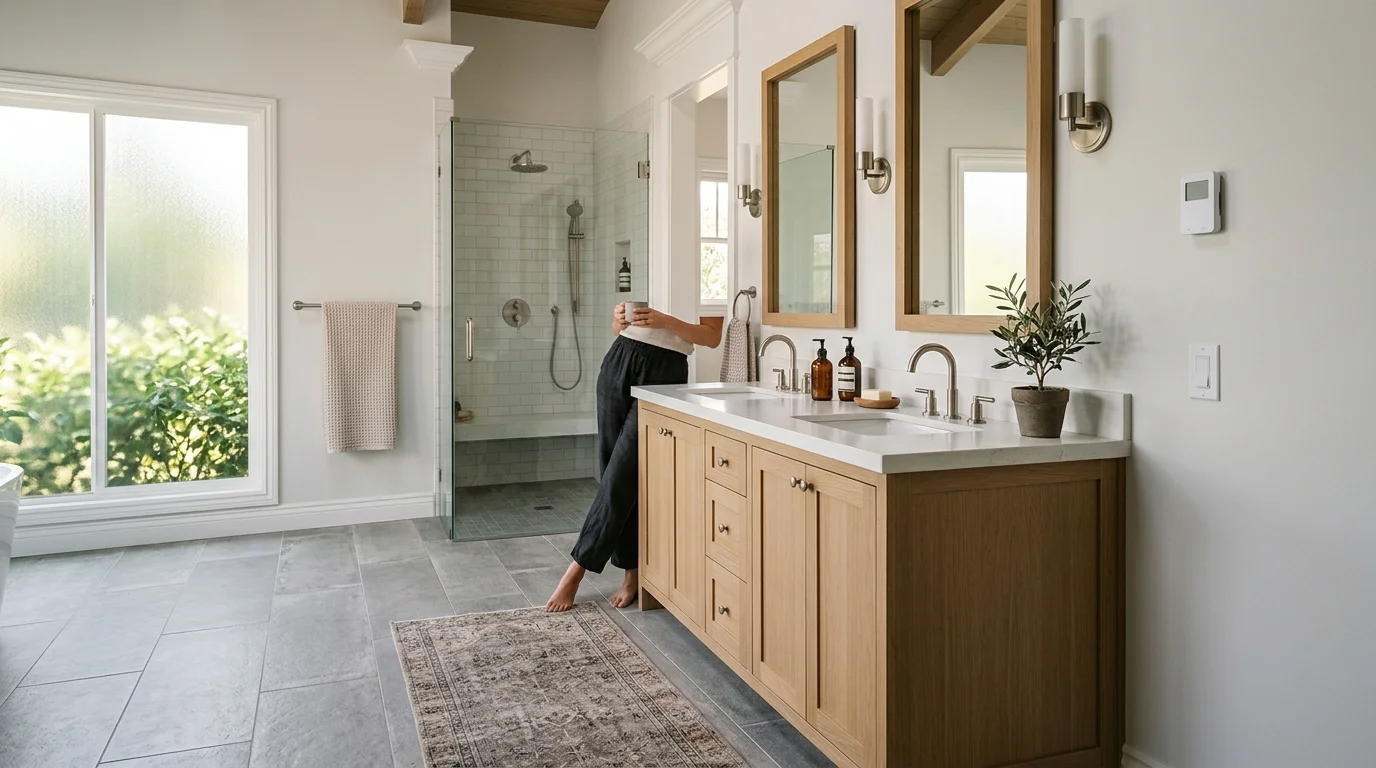
Tile on a slab in El Cajon can feel like a cold plate at 6 a.m., even when the rest of the house is fine. A Pacific Beach condo with the same porcelain often doesn’t. Heated bathroom floors in San Diego earn their keep in some rooms and waste budget in others. The split is climate, construction, and what else the floor still needs.
Bath Pro SD matches homeowners with licensed, independent local pros. We don’t install mats, pull wire, or set tile. The remodeler we connect you with does that work.
Electric mats vs hydronic in a single bathroom
For one bathroom, an electric radiant floor is the usual path. A bathroom floor heating mat, or a loose heating cable, sits in thinset or a leveling bed. Tile goes over that stack. A wall control runs the circuit. That setup stays inside the room. It doesn’t need a boiler closet.
Hydronic heat runs hot water through tubing in the floor. That system wants a boiler or a dedicated water heater, a manifold, and a larger mechanical footprint. It can make sense when a whole house is already going radiant. It is rarely the right scale for a single hall bath in Clairemont or a powder room in Point Loma.
Don’t treat the two as equal options for a typical San Diego remodel. Electric is a room product. Hydronic is a house product. If a salesperson pitches hydronic for one 5-by-8 bath, ask what else in the house would share that loop. If the answer is “just this floor,” the scope is probably wrong.
An electric mat still has to fit the room. Niches, toilets, and vanities don’t get heat under them the same way open floor does. The mat has to miss the toilet flange and the shower curb. It has to land at a wall box the electrician can actually reach. Large-format tile likes a flat bed. A lumpy mat layout fights that. The tile setter and the electrician have to plan the same floor, not two separate floors.
We don’t publish wattage, bill savings, or a price for this add-on. Those figures depend on the circuit, the mat, the tile mass, and how you run the wall control. None of that is confirmed in our claims file, so it doesn’t belong here as a number. Have the licensed electrician size the circuit. Have the tile setter confirm the mat and the thinset are compatible with the tile you picked in the bathroom tile buying guide.
If the job is a full gut, heat is easier to add than it is later. Once the floor is set, you’re not slipping a mat under finished porcelain. You’re tearing it up.
Why tile still feels cold in a mild climate
San Diego is not one climate. Inland North County (Escondido, San Marcos, Vista, Valley Center) and East County (El Cajon, Santee, Lakeside, Alpine, Ramona) drop hard at night in winter. Tile stores that cold. Bare feet hit it before the room air has caught up. Coastal strips from Imperial Beach through Ocean Beach, Pacific Beach, La Jolla, Del Mar, and Encinitas stay milder. The same porcelain in a PB condo often feels fine without heat.
Construction splits the county too. Slab-on-grade baths in Mira Mesa, Kearny Mesa, Rancho Peñasquitos, and large parts of Chula Vista sit on concrete that holds overnight chill. A second-story bath over living space in North Park or Mission Hills sits on a wood floor with a room underneath. That floor starts warmer. Older East County homes with raised floors and crawl spaces behave differently again. The tile is the same product. The mass under it is not.
Tile is dense. It pulls heat out of your feet faster than vinyl or wood. That is why a “mild” 58-degree morning still shocks you in El Cajon and barely registers in a La Jolla guest bath. Large-format porcelain makes it more obvious. More stone-like mass, more contact, colder first step.
Air conditioning in inland summers can keep the slab cool into the evening. Heat is not only a January feature in those houses. If you run the AC hard in Alpine or Escondido, the floor can feel cool in August too. Coastal houses with windows open to marine air have a different pattern. Don’t copy a national manufacturer page that treats San Diego like Minneapolis.
A heated tile floor is worth it when the room is used at dawn, the house sits inland or on a slab, and the floor is a large, hard surface. It is less worth it in a rarely used powder room, a coastal condo, or a bath that already has a rug habit. Comfort is local. The national “are heated floors worth it” pages won’t write that, because they are selling mats to every ZIP code at once.
What has to go down before the tile
Heat is one layer in a stack. It is not the first layer, and it is not the one that keeps the house dry.
Demo comes first. Then any floor repair, leveling, and the wet-area waterproofing. The heating mat or cable goes down after the floor is sound and the wet rooms are planned. Thinset and tile close the stack. If you reverse that order, you trap a mat under a floor that still needs a membrane, a slope, or a repair.
In the shower and at the bath perimeter, waterproofing does more work than heat. A warm floor over a failed wet area is still a failed wet area. Put the membrane, the slope, and the transitions right before anyone unrolls a mat. If the shower is part of the same remodel, read how the floor and the pan have to meet before you spend on heat.
The mat has to miss fixtures. Toilet wax rings, shower curbs, and vanity bases are not heating zones. Cables need a clear run to the wall control box. The tile setter lays the mat. The electrician lands the lead. If those two trades never talk, you get a mat that dies at a vanity leg or a lead buried where nobody can service it.
We don’t publish a list of shower-pan or waterproofing code specifics. That text was not confirmed for this site. The licensed pro on the job has to follow the product instructions and the inspector in your city. For a home in the City of San Diego, permits go through Development Services. Unincorporated communities (Ramona, Valley Center, Fallbrook, Alpine, Lakeside, Spring Valley, and the rest) go through County Planning & Development Services. Encinitas, Chula Vista, El Cajon, Escondido, Oceanside, and the other incorporated cities run their own building departments. Look up your jurisdiction. Don’t guess from a neighbor’s job.
A bathroom floor heating mat is not a weekend add-on on a finished floor. If the tile is staying, you’re not a candidate. If the tile is coming up anyway, heat can ride along with the new bathroom tile and flooring work. That is the window. Miss it, and the next chance is the next remodel.
Floor heat controls, GFCI, and which trade owns the work
Floor heat is electrical work in a wet room. That is not a tile-only job, and it is not a DIY mat from a box store with the existing lighting circuit.
A licensed electrician owns the circuit, the wall control, the wall box, and the protection on that circuit. Bathroom electrical already has a high bar because of water. Adding a floor load on top of lights, a fan, and receptacles is a design question, not a guess. We don’t publish which breaker, which GFCI device, or which permit trigger applies. Those details were not confirmed here. Have the electrician check the panel and the circuit. Have the City or County electrical inspector confirm what the permit requires for your address.
The floor heat control is a wall device. It needs a clean, reachable box, usually near the switch or just inside the door. Floor sensors sit in the thinset with the mat. If the sensor is under a rug zone, in a sun patch, or against a supply line, it will lie. The electrician and the tile setter place it together.
Which trade “owns” the floor: both. The electrician makes it safe and switchable. The tile setter makes it flat and covered. A general bathroom remodeler may coordinate both. Confirm who is on the CSLB license lookup before you sign. California treats unlicensed contracting as a misdemeanor. Work under $1,000 is exempt only when it is also casual or minor and no permit is required. Splitting a job to dodge that line is not allowed. Advertising as a contractor loses the exemption at any price.
Bath Pro SD does not hold a contractor license and does not pull permits. The matched local pro does. For the electrical side of a heated floor, start with bathroom electrical and lighting and the companion guide on bathroom electrical and lighting in a remodel. Those pages are the right cluster for this work. Heat is a line item on that electrical scope, plus a line item on the tile scope.
A home improvement contract in California has a deposit cap: $1,000 or 10 percent of the contract amount, whichever is less. On a large bath, that cap is $1,000, not 10 percent of the whole job. Get the heat, the tile, and the electrical in writing so you can see who is responsible when a mat fails or a wall control never gets programmed.
When to skip heat and put the money into waterproofing
Skip the mat when the floor still has a leak problem. Warm tile over a soft spot in El Cajon is still a soft spot. If the shower has stained grout, a spongy pan, or a history of ceiling stains below, waterproofing is the spend. Heat can wait for a floor that is already sound.
Skip it in rooms you barely use. A guest bath in a Solana Beach condo does not live the same life as a primary bath in Poway. Skip it on the coast if the room already feels fine in January. Skip it if the budget is already tight on the pan, the niche, the glass, and a panel that needs work. A heated floor on a weak electrical panel is the wrong sequence.
Put the money into waterproofing when you are in salt air (Imperial Beach, Ocean Beach, Pacific Beach, La Jolla) and the wet walls have taken years of moisture. Put it there in older East County houses where the pan, the mud bed, or the transitions were the original weak point. A dry floor you can stand on every morning beats a warm floor you have to tear out in three years.
Heat still earns its keep in a primary bath on an inland slab, used at dawn, with large-format tile and someone in the house who feels the cold. Aging-in-place work sometimes wants that comfort even when the rest of the bath is about grab bars and a curbless shower. Comfort and access can share a floor. They still don’t outrank a sound wet area.
If you are already opening the room, ask the licensed remodeler to price the floor two ways: tile and waterproofing alone, and the same stack with an electric mat. Compare those written numbers. We don’t publish a market range for heat, because we don’t have a verified one. A contract you can read is better than a blog figure.
The search “heated bathroom floors San Diego” is a comparison, not a shopping cart. Mats versus skip. Electric versus hydronic. Inland versus coast. Get that call right, then let the trades sequence the floor.
When to call us
Call when the bathroom floor is coming up anyway, and you need a licensed electrician and a licensed tile setter on the same stack. Call before the thinset goes down, not after. Call us at (858) 400-4896 and we’ll connect you with a licensed local bathroom remodeler.