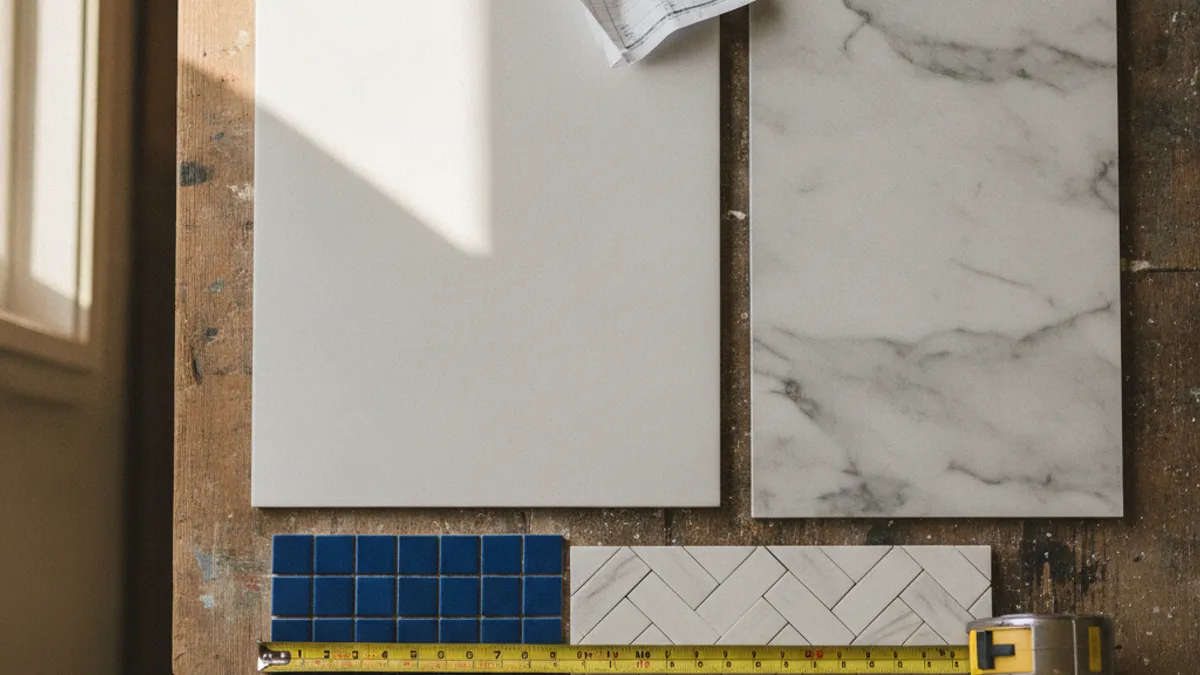
Why tile is the most important finish decision in a San Diego bath
Tile is the line item the homeowner sees every day, the line item that defines the design, and the line item that fails first if the install is wrong. A clean tile install solves four problems at once: a waterproof envelope in the wet zone, a slip-resistant floor under bare feet, a surface that holds up to coastal humidity, and a finish that reads as designed.
The tile move that works in almost every San Diego bath is a porcelain wall tile in 12x24 or 16x32 inches for the shower and tub surround, a porcelain mosaic in 2x2 inches for the shower floor, and a porcelain wood-look or stone-look plank for the bathroom floor. The moves that look good in a render and fail in a real bath are marble on the shower floor, polished tile on a bathroom floor, and grout that is not sealed.
This is a walk through the tile types, the waterproofing, the patterns, and the install decisions that matter in a San Diego bath remodel.
The three tile families, ranked
Porcelain tile. The right call for almost every San Diego bath in 2026. Porcelain is denser than ceramic, has a water absorption rate below 0.5%, and does not need sealing. It comes in every pattern that ceramic does, plus patterns that mimic marble, wood, concrete, and terrazzo.
Ceramic tile. A budget-friendly alternative to porcelain. Ceramic is softer, more porous, and easier to cut. It is fine for bathroom walls, bath floors with low traffic, and powder rooms. It is not the right call for a shower floor or a high-traffic master bath floor.
Natural stone (marble, travertine, slate, limestone). The premium option. Natural stone is porous, needs sealing twice a year, and etches on contact with acidic products. The payoff is a one-of-a-kind surface. Most San Diego designers use natural stone on a single accent wall, a shower niche, or a bench, and use porcelain on the wet zone floor.
The bathroom tile page has the line items for a typical install, and the heated bathroom floor angle is on the same page under the floor heat line item.
Shower wall tile choices
The most common shower wall tile in 2026 San Diego remodels is a large-format porcelain in 12x24, 16x32, or 24x24 inches. Large format reads modern, has fewer grout lines, and is faster to install. The substrate has to be flat, and the corners have to be detailed to avoid the lippage a small tile would hide.
The second most common is a subway tile in 3x6 or 4x8 inches. Subway reads classic, has more grout lines, and is more forgiving on an out-of-flat wall. A beveled subway in a 2x6 or 3x12 size is the design-forward choice for a primary suite.
The third is a mosaic accent strip or a full mosaic wall. A mosaic in 1x1, 2x2, or hexagonal patterns is the right call for a niche, a bench, or a single accent wall. It is the wrong call for a full shower wall, because the grout lines are too busy at scale.
For most San Diego remodels, the right call is a 12x24 or 16x32 porcelain on the main walls, a 2x2 or 4x4 mosaic on the shower floor, and a single accent strip or niche. The shower tile line items are on the shower remodel page.
Shower floor tile choices
The shower floor has three requirements that the wall tile does not: it has to follow the slope of the pan, it has to be slip-resistant, and it has to be cuttable around the drain. Three patterns work:
- 2x2 or 4x4 porcelain mosaic on a mesh sheet. The most common and the most forgiving. The small tile follows the slope of the pan, gives grip under bare feet, and cuts easily around a center or linear drain.
- Hexagonal porcelain mosaic. The design-forward choice. Hex tiles in 1-inch or 2-inch sizes follow the slope, give grip, and read as a pattern. Hex is more expensive than a square mosaic.
- Pebble tile (river rock on a mesh sheet). The high-end choice. Pebble tile is naturally slip-resistant, follows the slope, and reads as a spa. It is the most expensive.
The wrong call for a shower floor is a polished porcelain, a marble, or a tile larger than 4 inches. Polished tile is slippery when wet, marble pits in hard water, and large tile does not follow the slope of a standard pan.
Bathroom floor tile choices
The bathroom floor has different requirements than the shower floor. It does not need to follow a slope, it does get wet from splashing, and it takes more abuse than the shower wall.
Three patterns work for a San Diego bath floor:
- Porcelain wood-look plank in 6x24 or 8x36 inches. The most popular choice in 2026. Wood-look plank reads warm and hides dirt. Ask the installer to price this material after the layout.
- Porcelain stone-look tile in 12x24 or 24x24 inches. The right call for a modern or coastal design. Ask the installer to price this material after the layout.
- Hexagonal or patterned porcelain. The design-forward choice. A 6-inch or 8-inch hex in a solid color or a pattern. Ask the installer to price this material after the layout.
For a heated floor, the right call is a porcelain tile installed over a Schluter DITRA-HEAT or similar uncoupling membrane with electric heat cable. Ask the electrician and tile setter to price the heat system with the floor layout.
Waterproofing the wet zone
The wet zone is the shower and the tub surround. Three waterproofing methods work in San Diego:
- Schluter Kerdi system (bonded polyethylene membrane). The standard in 2026. The Kerdi membrane is applied to the walls and the shower pan with thinset, the corners are pre-formed, and the drain has a bonding flange that ties into the membrane. Code-compliant and manufacturer-warrantied. Ask the independent remodeler to price this after measuring.
- Vinyl pan liner with a mud bed. The traditional method. A continuous PVC or CPE liner is installed in the shower pan before the mud bed is poured. Code-compliant and the right call for a curbless or out-of-ordinary shape. Ask the independent remodeler to price this after measuring.
- RedGard or similar liquid-applied membrane. The budget option. A liquid waterproofing is painted on a cement board or mud pan in two or three coats. The most failure-prone of the three. Ask the independent remodeler to price this after measuring.
The right call for most San Diego bath remodels is the Schluter Kerdi system. The result is a shower that does not leak for 20+ years.
Grout, caulk, and movement joints
The grout and the caulk are the line items that fail first if the install is wrong. Three rules:
- Use unsanded grout on wall tile with joints under 1/8 inch. Sanded grout on a tight joint does not pack fully and fails.
- Use sanded grout on floor tile with joints over 1/8 inch. Unsanded grout on a wide joint cracks under load.
- Caulk (not grout) every change of plane. The corners where the wall meets the floor, the wall meets the wall, and the wall meets the ceiling need a flexible caulk, not grout. Grout in a corner cracks at the first movement of the house, and the crack becomes a leak path.
A 100% silicone caulk in a color matched to the grout is the right call for a wet zone. A pre-mixed urethane grout caulk (like Mapei Keracaulk) is the upgrade that lasts longer and is easier to clean.
What a San Diego bath tile install actually costs
A typical San Diego bath tile install (shower walls, shower floor, bathroom floor) for a 40-65 square foot bath is priced after the tile setter measures the wet zone. The line items:
- Schluter Kerdi waterproofing (shower): priced after measuring.
- Shower wall tile (porcelain, 60-90 sq ft): priced after measuring.
- Shower floor tile (mosaic, 12-20 sq ft): priced after measuring.
- Bathroom floor tile (porcelain, 30-50 sq ft): priced after measuring.
- Heated floor system (optional, 30-50 sq ft): priced after measuring.
- Tile labor (shower walls, floor, bath floor): priced after measuring.
For most projects, the tile material and the labor are the two line items that move the budget. A mid-range porcelain with mid-range labor lands in the mid-range. A bookmatched marble with high-end labor climbs to the high end.
What to ask a tile contractor
Three questions separate a clean tile install from a corner cut:
- What is your waterproofing method? Schluter, vinyl liner, or RedGard. The first two are code-compliant. The third can be, but the right answer depends on the installer.
- What is your substrate prep? A flat substrate is the difference between a tile install that lasts and a tile install with lippage and cracks. The answer should include a self-leveling underlayment for the floor and a flat wall check.
- What is your grout and caulk plan? Sanded vs. unsanded for the grout, and silicone or urethane caulk at every change of plane.
A good crew will not flinch at any of these questions. For the full bath tile scope, the bathroom tile page has the line items and the project timeline.
Call (858) 400-4896. Bath Pro SD matches you with a licensed independent remodeler. That person measures the room and writes the scope and price. The crew measures the bath, checks the substrate, and tells you what tile, what pattern, and what waterproofing system fits the room and the budget, and what the install actually costs.