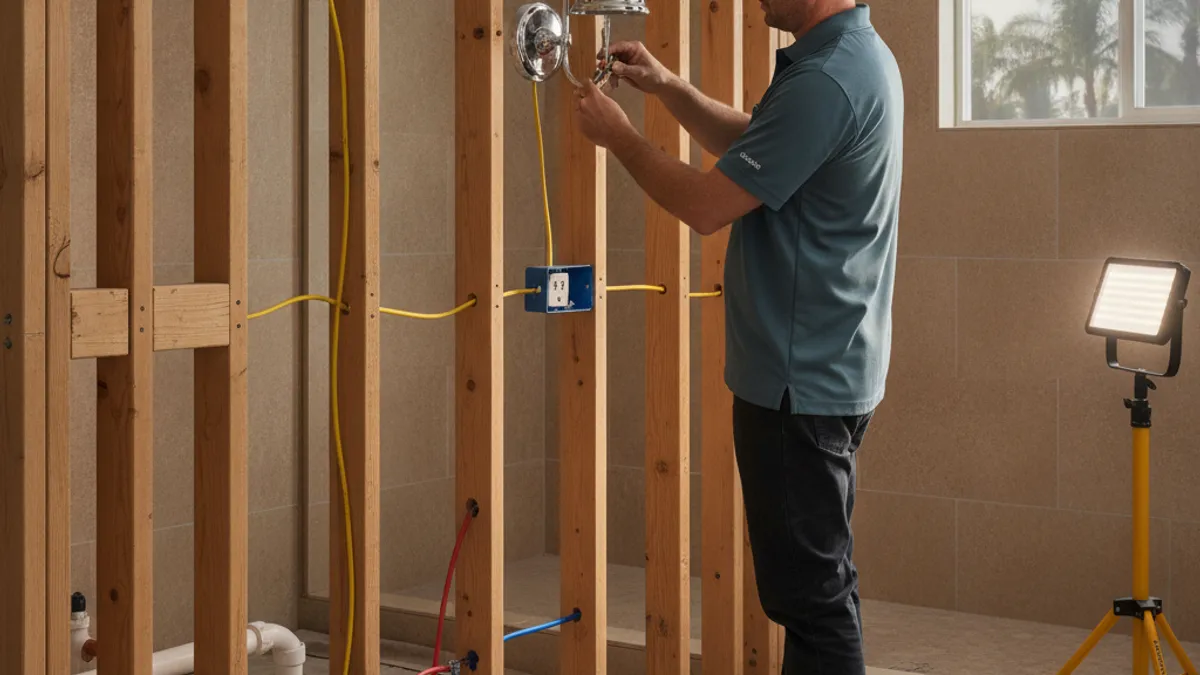
Why the electrical rough-in is the second-most under-scoped line item in a San Diego bath
A bathroom electrical rough-in is the work that powers every other piece of the remodel, and it is the work that fails the inspection if it is wrong. A clean rough-in solves four problems: it puts the right number of circuits in the right place, it integrates GFCI and AFCI protection as the code requires, it provides the lighting the bath actually needs, and it passes rough inspection the first time.
A typical San Diego bath electrical rough-in is priced after the electrician sees the panel, the existing circuits, and whether a heated floor is in the plan. The right call for any bath remodel is to pull all new wire, not to reuse the old circuits, and to bring the bath up to current code while the walls are open.
This is a walk through the circuit requirements, the GFCI and AFCI rules, the lighting and fan choices, and what a bath electrical scope actually costs.
The circuit rules a bathroom must follow
The California Electrical Code (CEC), which adopts the National Electrical Code with California amendments, requires the following circuits in a bathroom:
- One 20-amp circuit for the vanity and bathroom receptacles. Most San Diego baths also have a separate 20-amp circuit for a heated floor.
- One 15-amp or 20-amp circuit for the lighting. A separate lighting circuit is the right call. The lighting circuit should be AFCI-protected per the 2022 CEC.
- One 15-amp or 20-amp circuit for the exhaust fan. A dedicated circuit is the cleanest approach, but most electricians share the fan with the lighting circuit.
- One 20-amp circuit for a heated floor (if applicable). A heated floor system draws 8-15 amps and needs a dedicated 20-amp circuit with a GFCI breaker.
- One 20-amp circuit for a whirlpool or air-jetted tub (if applicable). A jetted tub motor draws 10-15 amps and needs a dedicated GFCI-protected circuit.
The wrong call is reusing a single 15-amp circuit for the vanity, the lighting, and the exhaust fan. This is the most common code violation in older San Diego baths. The fix is to pull new 20-amp circuits for the receptacles and the lighting.
The bathroom electrical page has the circuit and breaker line items, and the heated floor line items are on the bathroom tile page under the floor heat section.
GFCI and AFCI: what the code actually requires
Ground-fault circuit interrupter (GFCI) protection and arc-fault circuit interrupter (AFCI) protection are the two biggest changes in the last three code cycles.
GFCI requirements. All 125-volt receptacles in a bathroom must have GFCI protection. This includes the vanity receptacles and any receptacle within 6 feet of a sink. The GFCI protection can be at the breaker or at the first receptacle in the run. Most San Diego electricians install GFCI breakers for the bath receptacle circuit and for the heated floor circuit.
AFCI requirements. The CEC requires AFCI protection for the bathroom lighting circuit. AFCI breakers detect arcing faults and trip before the arc starts a fire. AFCI+GFCI combination breakers are the most common solution. The electrician prices the breaker after seeing the panel.
What changed. Before 2014, GFCI was required only for receptacles within 6 feet of a sink. Before 2017, AFCI was not required for bathroom lighting. The 2020 NEC (and the 2022 CEC) expanded both to the rules above.
Lighting design that actually works in a San Diego bath
The code sets the minimum, and most homeowners want more than the minimum. Three lighting layers are worth folding into a bath remodel:
1. Ambient (overhead) lighting. A 4-inch or 6-inch LED can on a 0-10V dimmer, spaced 4-6 feet apart in the ceiling, on the lighting circuit. Most San Diego baths need 4-8 cans for even ambient coverage.
2. Vanity (task) lighting. A vanity bar light, a pair of sconces, or a vertical LED strip mounted to the mirror. The right call for a single vanity is a 24-30 inch fixture mounted 75-80 inches above the floor. A 3000K-3500K color temperature is the right call for makeup application.
3. Shower (task) lighting. A wet-rated recessed LED can in the shower ceiling, on the same lighting circuit as the ambient cans. The fixture has to be wet-rated, not just damp-rated, and it has to be on a GFCI-protected circuit.
The right number of switches is 3-4: ambient, vanity, shower, and exhaust fan. Putting all of the lighting on one switch is the most common lighting mistake in a bath remodel.
The bathroom lighting line items are on the bathroom electrical page.
Exhaust fan choices that matter
The exhaust fan is the line item most often under-sized in a San Diego bath. The code requires a fan that moves at least 50 cubic feet per minute (CFM) for a bath under 50 square feet, and 50 CFM more for each toilet, shower, or tub.
Three fan choices are common in San Diego:
- A standard ceiling-mounted fan with a 4-inch duct. A 50-110 CFM fan with a 0.5-1.5 sones rating. The most common and the most affordable. Ask the independent remodeler to price this after measuring.
- A humidity-sensing fan. A fan with a humidity sensor that turns on automatically when the relative humidity in the bath rises above a set point. Ask the independent remodeler to price this after measuring.
- A quiet ceiling-mounted fan with a 6-inch duct. A 110-150 CFM fan with a 0.3-0.7 sones rating. The right call for a primary suite. Ask the independent remodeler to price this after measuring.
The wrong call is a 50 CFM fan in a 100 square foot bath, a fan vented into the attic, or a fan on the same switch as the lighting.
Heated floor circuit work
A heated floor system in a San Diego bath is mostly an electrical rough-in. Ask the electrician to price it after seeing the panel. The system has three parts:
- The heating mat or cable. A 120V or 240V electric mat or cable that is installed on the subfloor or in a thinset layer. The mat is sized to the heated area (typically 30-60 square feet in a typical bath).
- The wall control. A 120V or 240V wall control that operates the mat. The wall control is mounted in the same wall as the vanity, usually at 48-60 inches above the floor.
- The dedicated 20-amp circuit. A GFCI-protected circuit that runs from the panel to the wall control.
The electrical rough-in for a heated floor needs to happen before the tile is installed, and the mat needs to be installed before the tile is set. The right call is to add the heated floor to the design package, not as a change order during the tile phase.
The heated floor line items are on the bathroom tile page.
Common San Diego bath electrical problems
Five recurring problems show up in older San Diego bath electrical:
1. The panel is full. A 100-amp panel with a fuse box or an early-breaker panel does not have space for the new bath circuits. The fix is a panel upgrade to 200 amps. Some homes need a subpanel instead. Ask the independent remodeler to price this after measuring.
2. The wire is aluminum. A 1960s-1970s San Diego home may have aluminum branch circuit wiring. The fix is to pull new copper for the bath circuits. The electrician prices that pull after opening the walls.
3. The bath is on a single 15-amp circuit. The most common code violation. The fix is to pull two 20-amp circuits plus a separate circuit for the heated floor if applicable. Ask the electrician to price that work after seeing the panel.
4. The exhaust fan is vented into the attic. A code violation in most jurisdictions and a leading cause of attic mold. The fix is to re-route the duct to a sidewall or roof vent, and the electrician prices the duct reroute after seeing the attic.
5. The vanity light is on a switched receptacle with a corded lamp. A 1950s-1970s code workaround that is no longer code-compliant. The fix is to hardwire the vanity light.
What a San Diego bath electrical scope actually costs
Bath Pro SD does not set electrical prices. A standard bath rough-in, a bath with a heated floor and a humidity-sensing fan, and a bath that also needs a panel upgrade are three different quotes. Ask the electrician for written lines after seeing the panel.
The line items for a typical scope:
- New 20-amp receptacle circuit: priced after measuring.
- New 15-amp lighting circuit (AFCI): priced after measuring.
- GFCI breakers (2): priced after measuring.
- AFCI breaker (1): priced after measuring.
- Vanity light fixture and rough-in: priced after measuring.
- Shower light fixture and rough-in: priced after measuring.
- Exhaust fan and rough-in: priced after measuring.
- Heated floor circuit (if applicable): priced after measuring.
- Subpanel (if needed): priced after measuring.
- Permit and rough inspection: priced after measuring.
For most projects, the lighting fixture and the fan are the line items that move the budget the most.
What to ask a bath electrical contractor
Three questions separate a clean electrical scope from a corner cut:
- Are you pulling all new wire, or reusing any of the existing branch circuits? A remodel is the right time to bring the bath up to current code, and the answer should be “all new wire.”
- Are you using AFCI+GFCI combination breakers, or standard breakers? The 2022 CEC requires AFCI on the bath lighting, and the answer should be combo breakers.
- Who is calling for the rough and final inspections? The contractor, not the homeowner, and the inspections should be on the schedule before the drywall goes up.
A good crew will not flinch at any of these questions. For the full bath scope that pairs with the electrical work, the full bathroom remodel page has the line items and the project timeline.
Call (858) 400-4896. Bath Pro SD matches you with a licensed independent remodeler. That person measures the room and writes the scope and price. The crew looks at the panel, the existing wiring, and the planned layout, and gives you a written scope for the electrical side of the bath remodel with a real budget. The bathroom electrical page has the full circuit and lighting line items.