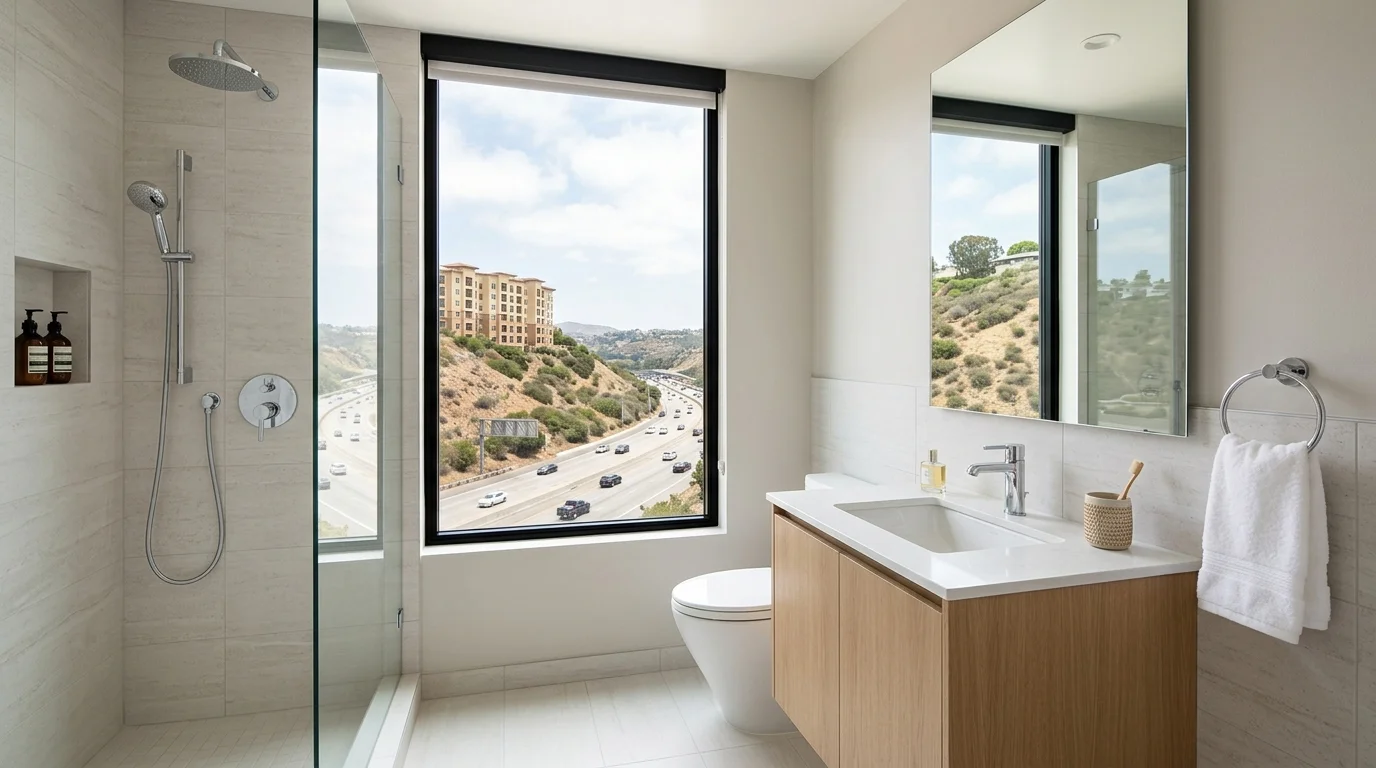
The shower in a Friars Road condo does not live on its own plumbing. The drain in your floor is often the ceiling of the unit below, and the HOA will treat a leak as a building problem. In Civita, Fashion Valley, Hotel Circle, and the rest of the I-8 hotels-to-housing belt, a full bathroom remodel runs through the neighbor, the association, and City of San Diego Development Services. The finishes are yours to choose. The pipes are not yours alone.
Shared stacks and why the unit below is part of the job
In a detached house, a plumber can open a wall and chase a line with some room to think. In a stacked Mission Valley condo, the wet wall is a vertical chase shared by several units. The toilet flange, shower drain, and lavatory waste often land on the same stack. Move a toilet a few inches and you may be asking to cut into a neighbor’s ceiling.
The valley filled in waves. Older slabs sit near Hotel Circle, Hazard Center, and Mission Center Road. Newer podium buildings cluster around Civita, the San Diego River, and the Fashion Valley edge. In both types, bathrooms tend to stack on bathrooms. The unit below is not a courtesy call. It is part of the job because a pan leak, a bad coupling, or a misaligned drain shows up in their drywall first.
A licensed plumber should confirm how your unit is tied in before anyone demos tile. Ask the HOA for as-builts if they keep them. Many associations do not. Then the pro inspects from inside your bath and, with written notice, from the unit below if the ceiling has stains or an access panel.
Do not assume you can relocate a shower because a floor plan looks open. In a stack, the drain is where the building put it. A bathroom plumbing change that looks small on paper can mean opening two units, not one. Confirm plumbing-stack rules with the HOA and with the City of San Diego Development Services before you sign a layout that moves fixtures.
If water has already stained the ceiling below, pause the finish decisions. Find the leak path. A remodel that tiles over a wet floor does not fix the stack. It hides it until the next HOA letter.
California treats this as home improvement work. A contractor license is required unless the total price for labor and materials is under $1,000, the work is casual and minor, and no building permit is required. All three conditions must hold. Splitting a job into smaller contracts to dodge the license is not allowed. Anyone who advertises as a contractor loses the exemption at any price. Confirm the number on the CSLB license lookup before a deposit changes hands.
Building shutoffs, work hours, and debris rules
Condo work lives on the building’s clock, not the crew’s. Water for a stacked bath often shuts off at a riser or a corridor closet, not only at your angle stops. That valve can take other units offline. The association, not the homeowner, usually controls who may turn it and when.
Do not guess the rule. Get the architectural guidelines and the construction rules in writing. Ask, in plain terms, where the water shutoff for this stack is, who is allowed to operate it, and how much notice neighbors on the stack need. Ask what hours demolition, saws, and tile grinding are allowed. Ask how debris leaves the building: stairs, freight elevator, or parking podium. Ask whether a dumpster stall or loading space needs a reservation.
Those answers vary by association. A Civita mid-rise does not run like a two-story walk-up off Camino de la Reina. Elevator windows, quiet hours, and loading-dock rules show up often in this corridor. Specific fees, hour blocks, and reservation costs were not confirmed for this page, because they belong to each HOA. Read the packet for your building. Do not copy a neighbor’s memory from a different stack.
Work hours matter more here than in a detached house. Tile saws echo down concrete corridors. Demo dust rides the HVAC. Neighbors on both sides of the party wall will hear every cut. A licensed remodeler who has worked Mission Valley condos will plan noisy work inside the building’s window and will protect common-area floors on the way out.
Debris is a building problem. Bagged tile and a sawn tub cannot sit in a hallway overnight unless the rules say they can. Confirm the path: unit door, corridor, elevator or stair, garage, street. Friars Road and Hotel Circle loading is tight, and I-8 traffic does not wait on a dumpster that never got a stall. Street parking along the freeway frontage is not a loading plan.
A city permit, when the scope needs one, does not replace HOA rules. You still need both tracks. Our guide to bathroom remodel permits in San Diego covers the city side. The association packet covers the building side. Naming what trips a permit is a city call, not something to take off a blog list.
What an HOA actually reviews inside a Mission Valley unit
HOA review in a Mission Valley condo is a different job than a Scripps Ranch townhome board. Those suburban files often turn on roofs, stucco, and yards. Here the board is looking at wet work inside a stacked shell: waterproofing, noise, shared plumbing, and anything that changes a common-element floor or wall. If you want the suburban HOA path spelled out, that lives on our HOA bathroom remodel approvals page. This one stays on the valley stacks.
What a Mission Valley association may ask for, if the guidelines require an architectural application, is a written scope, a fixture layout, and a waterproofing note at the shower and floor. They may want proof the contractor is licensed, insurance certificates in the form the CC&Rs name, a work schedule that respects building hours, a shutoff plan, and a debris path through common areas.
That is a planning list, not a promise of what your board will demand. Read your CC&Rs and architectural guidelines. Some associations treat a like-for-like vanity swap as owner work. Others treat any shower pan as an application. There is no single San Diego HOA bathroom remodel rule. We could not confirm one, because each building writes its own.
Hard-surface floors, in-floor heat, and heavier tile can raise questions about sound into the unit below. If the guidelines mention acoustic underlayment, follow that document. Do not invent a rating and hope the manager agrees later.
Submit before demo, not after. You are asking to open a wet room that sits on someone else’s ceiling, often over a podium garage, in a river valley that already funnels noise from I-8 and SR-163. Do not start tile because a manager said it should be fine in the lobby. Get the written approval your CC&Rs require. If the board is silent on interior baths, get that silence in writing too.
The down payment on a home improvement contract cannot exceed $1,000 or 10 percent of the contract amount, whichever is less. On a large bath, that cap is $1,000, not 10 percent of the whole job. Pay it only after you have a written contract, a license number you have checked, and a clear note of who handles any city permit.
Podium and slab construction along I-8
Mission Valley is a river corridor, not a hillside suburb. Much of the housing between Fashion Valley, Friars Road, and the I-8 hotels sits on podium construction: parking and retail on the lower levels, residential stacks above. Older pockets use post-tension or conventional slabs. Both change how a bathroom comes apart.
On a podium building, your bath floor may be a lightweight topping or a framed assembly over occupied space. Drilling, saw-cutting, and setting a new shower drain are not casual. Hit the wrong thing and you can nick post-tension cables, a fire-rated assembly, or a waterproofing membrane that belongs to the building, not to you.
On an older slab unit near Hotel Circle or Mission Center, drains may be cast in. Relocating a shower can mean core drilling that the HOA will refuse, or that a structural review has to touch. A condo shower remodel in San Diego only works inside those limits. Keep the shower where the stack already is unless a licensed pro, the HOA, and the city all agree a move is possible.
Moisture behaves differently in these buildings too. The valley sits low, with marine layer in the morning and hot inland air by afternoon. Tight condo baths with weak exhaust hold steam against party walls. A remodel is the moment to put in a fan that actually vents out, not into a soffit. Specific fan ratings and fixture flow numbers are not listed here. That energy-code text was not verified for this site. Ask the licensed electrician and the city reviewer what the current mechanical rules require.
Fire-rated walls and acoustic assemblies are common-element issues. Opening a wet wall to move a valve can mean restoring a rating, not just closing drywall. That is another reason the HOA packet matters, and another reason a quote that ignores the stack is the wrong quote.
Street access is part of construction. I-8, SR-163, and I-15 pinch this valley. Material deliveries that work in Santee do not work the same at a Fashion Valley curb at noon. The pro you hire should plan staging with the building, not with a hope of finding a loading zone on Friars.
Sequencing the work when you only have one bathroom
Plenty of Mission Valley condos have a single bath. Some two-bedroom stacks still share one full bath plus a powder that cannot take a shower. When that full bath goes down, you are without a working shower in a neighborhood lined with hotels and offices, not guest rooms of your own.
Sequence the job so the stack is open for the shortest honest window, not the prettiest one.
Paper first. HOA application, neighbor notices, and a city permit if the scope needs one. Do not demo on a maybe. Confirm the shutoff and the debris path on the same week. Photograph the unit below, with permission, before work starts, so everyone can see the ceiling as it was.
Demo to the substrate. Inspect the pan, the flange, and the valve rough-in. Plumbing and waterproofing come next. Tile only after the pan and walls are actually watertight. Restore common areas as you go, not on the last day, because a scuffed corridor is an HOA problem before it is a punch-list item.
If you need a working toilet during the job, plan that before contracts. Some owners stay with family in Serra Mesa or Linda Vista. Some use a gym near Fashion Valley. Some pause after plumbing rough-in so a toilet can go back on a flange for nights and weekends, then come off for finish work. That last option only works if the licensed plumber agrees it is safe and the HOA allows the stop-and-start. Do not assume it.
A one-bath unit also punishes scope creep. Keep the toilet, shower, and sink on their existing centers if the layout already functions. A Mission Valley condo remodel is often a better bath in the same footprint: new pan, new valve, new surfaces, better fan. Moving a shower three feet is the expensive decision, and in many of these buildings it is the one the stack will not allow.
Unlicensed contracting is a misdemeanor under California law. If the work needs a permit, the small-job exemption does not apply even under $1,000. Hire a licensed independent pro, keep the stack in mind, and treat the unit below as part of the room you are remodeling.
When to call us
Call when the bath you want sits on a shared stack, needs an HOA packet, or is the only bathroom in the unit. Bath Pro SD matches Mission Valley owners with licensed, independent local remodelers. We do not pull permits, cut tile, or open walls. Call us at (858) 400-4896 and we’ll connect you with a licensed local bathroom remodeler.