Why aging-in-place is the fastest-growing reason for a San Diego bath remodel
Most homeowners think a bathroom remodel is about tile, glass, and a new vanity. For a growing number of San Diego households, the remodel is about staying in the home through retirement, recovering from a surgery, or hosting an aging parent who can no longer climb into a standard tub. The work is the same trades (demo, plumbing, tile, glass) but the design decisions are different, and the cost is often 10-20% higher than a standard remodel because the accessibility features add line items.
A clean aging-in-place bath remodel solves four problems: it removes the tripping hazards (the tub wall, the throw rugs, the low toilet), it adds the support features (grab bars, blocking in the walls, a curbless shower, a comfort-height toilet), it lays out the fixtures for wheelchair or walker access, and it does it without making the bath look like a hospital.
This is a walk through the four most common aging-in-place bath projects, the design rules that matter, and what a San Diego aging-in-place remodel actually costs.
The four project types, ranked
1. Curbless shower conversion with grab bars. The most common aging-in-place project in San Diego. A standard 60-inch alcove tub is removed, the wet zone is converted to a curbless walk-in shower, a teak fold-down seat is added, and 2-3 grab bars are installed in blocking that was added to the wall framing during the rough-in. Ask the remodeler to price pan, glass, seat, and bars as separate lines.
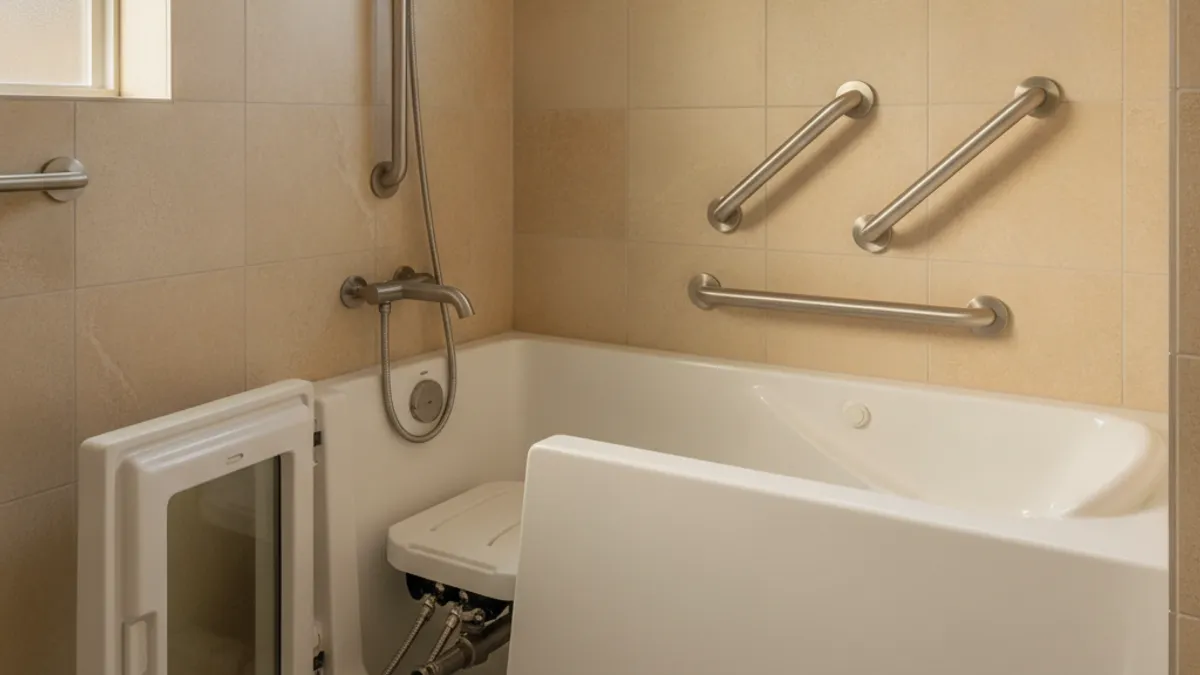
2. Walk-in tub with a sealed door and built-in seat. The right call for a homeowner who soaks daily and cannot step over a 14-18 inch tub wall. A walk-in tub has a sealed door that opens inward, a built-in seat, a handheld showerhead, and a thermostatic valve that prevents scald. Ask the plumber to price the tub, drain, and valve after measuring the alcove.
3. Full aging-in-place remodel with a 60-inch curbless shower, comfort-height toilet, blocking in the walls, wider doorway, and reinforced blocking for future grab bars. The right call for a household that is remodeling the bath now and wants the option to add a grab bar, a transfer bench, or a wheelchair-accessible vanity in the next 5-15 years without re-opening the walls. Ask the independent remodeler to price this after measuring.
4. ADA-minded primary suite remodel with a roll-in shower, a wall-hung toilet, a roll-under vanity, a 36-inch doorway, and lever-style hardware on every door and faucet. Private homes are not automatically bound to ADA Access Board rules. This layout is for a wheelchair user, a household member with a long-term mobility limitation, or a homeowner building a forever home. Ask the independent remodeler to price this after measuring.
For most San Diego households, the curbless shower conversion with grab bars is the right answer. It solves the safety problem at the lowest cost, and it does it without the institutional feel of a true ADA bath. The walk-in tub page has the line items for the tub-only project, and the aging in place bathroom angle is on the same page.
The design rules that matter
Aging-in-place design follows the Americans with Disabilities Act (ADA) standards for accessibility, even though ADA itself is a commercial standard. The residential version is sometimes called “universal design” or “visitability.” The rules that matter most for a San Diego bath remodel are:
Clear floor space. A 60-inch turning radius is the ADA standard for a wheelchair turn. Most San Diego aging-in-place remodels target a 5-foot turning radius. The minimum clear floor space in front of the toilet, the shower, and the vanity is 30 inches wide by 48 inches deep.
Toilet height. A comfort-height toilet is 17-19 inches from floor to seat top, versus a standard 14-15 inches. Comfort-height is the right call for any aging-in-place bath. A wall-hung toilet with a hidden tank is the design-forward choice that lets the homeowner adjust the height later. Ask the independent remodeler to price this after measuring.
Shower threshold. A curbless or low-threshold (under 2 inches) shower entry is the right call. The curbless install is the same as a standard conversion plus a subfloor correction and a linear drain at the back wall.
Grab bars. A 36-inch grab bar on the control wall, a 42-inch grab bar on the back wall, and a vertical grab bar at the entry are the standard set. The bars need solid blocking in the wall framing, and the blocking has to be added during the rough-in.
Shower seat. A fold-down teak seat, a fold-down phenolic seat, or a built-in tiled bench are the three options. The fold-down is the right call for a bath used by both seated and standing bathers. A built-in bench is the right call for a steam shower.
Doorway width. A 32-inch clear doorway is the standard for a residential bath. A 36-inch clear doorway is the right call for a wheelchair or walker user. Most pre-1990 San Diego tract homes have a 28-30 inch doorway, and the door and jamb have to be reframed. Ask the carpenter to price that reframing as its own line.
Lever hardware. Lever-style door handles and faucet handles are the right call for any aging-in-place bath. Ask the independent remodeler to price this after measuring.
The ada bathroom line items are on the walk-in tub page, and the curbless shower angle is on the shower remodel page.
The blocking decision
Blocking is the wood or metal that gets installed between the wall studs to give grab bars, shower seats, and future accessories something solid to screw into. Blocking is cheap compared with opening tile later, but the labor has to happen during the rough-in, which means adding blocking to an existing bath requires opening the wall.
The right call for any aging-in-place bath remodel, even if no grab bars are being installed yet, is to add blocking at:
- The shower control wall, at 36 inches and 42 inches above the floor
- The shower back wall, at 36 inches above the floor
- The toilet side wall, at 33-36 inches above the floor (for a future side grab bar)
- The vanity wall, at 36 inches above the floor (for a future horizontal grab bar)
- The shower entry, at 60 inches above the floor (for a future vertical grab bar)
Adding blocking during a remodel is cheap. Adding blocking after the tile is up means re-opening the wall, retiling, and re-waterproofing. The decision is one of the easiest ways to future-proof a bath without adding any visible accessibility features today.
The walk-in tub decision
A walk-in tub is the right call for a homeowner who soaks daily and cannot step over a standard tub wall. It is the wrong call for a household that does not soak, because a walk-in tub has a longer fill time, a longer drain time, and a smaller bathing space than a standard tub.
The features that matter on a walk-in tub:
- A sealed inward-opening door. The door has to seal fully before the tub fills. The right call is a tub with a single-lever or push-button door.
- A built-in seat. A 17-21 inch wide seat at the right height for the bather. The right call is a contoured seat, not a flat bench.
- A thermostatic valve with an anti-scald device. Required by code in California, and a must for an aging bather. The right call is a valve with a high-temperature limit stop.
- A handheld showerhead on a slide bar. The right call for a seated bather.
- A heated backrest and seat (optional). Ask the remodeler to price this add-on.
- Air jets and water jets (optional). Ask the remodeler to price this add-on. The right call for a bather with arthritis or chronic pain.
A walk-in tub is priced by the independent remodeler after measuring, including the tub, rough-in, and install.
What a San Diego aging-in-place remodel actually costs
Bath Pro SD does not set aging-in-place prices. A curbless conversion with grab bars, a walk-in tub install, a full aging-in-place remodel with blocking and a wider doorway, and an ADA-minded primary suite are four different quotes. Ask the independent remodeler to write the scope after measuring.
The line items for a typical curbless conversion with grab bars:
- Design consult and layout: priced after measuring.
- Demo of the tub, surround, and door: priced after measuring.
- Plumbing rough-in and valve: priced after measuring.
- Drain move for the curbless pan: priced after measuring.
- Schluter foam pan and waterproofing: priced after measuring.
- Shower wall tile: priced after measuring.
- Shower floor tile: priced after measuring.
- Frameless glass (fixed panel, no door): priced after measuring.
- Grab bars (3-4) with blocking: priced after measuring.
- Fold-down teak seat: priced after measuring.
- Comfort-height toilet: priced after measuring.
- Blocking in the walls (5-7 locations): priced after measuring.
- Doorway reframing (if needed): priced after measuring.
- Permits: priced after measuring.
For most projects, the tile and the plumbing are the line items that move the budget the most. A mid-range porcelain with a mid-range valve lands in the mid-range. A bookmatched marble with a thermostatic valve and a linear drain climbs to the high end.
What to ask an aging-in-place remodel contractor
Three questions separate an aging-in-place specialist from a generalist:
- Have you added blocking for future grab bars during previous remodels? The right answer is yes, and the homeowner should be able to point to specific blocking locations in the rough-in photos.
- Do you follow the ADA standards for residential baths, or universal design guidelines? ADA is the commercial standard. Universal design is the residential version. Either is fine, but the answer should be specific.
- What is your lead time on a walk-in tub? A custom walk-in tub with a sealed door and a built-in seat runs 4-10 weeks. A 1-week promise is a red flag.
A good crew will not flinch at any of these questions. For the full bath scope that usually pairs with an aging-in-place project, the full bathroom remodel page has the line items and the project timeline.
Call (858) 400-4896. Bath Pro SD matches you with a licensed independent remodeler. That person measures the room and writes the scope and price. The crew measures the bath, looks at the doorway and the framing, and tells you whether a curbless conversion, a walk-in tub, or a full aging-in-place remodel is the right call, and what the project actually costs.