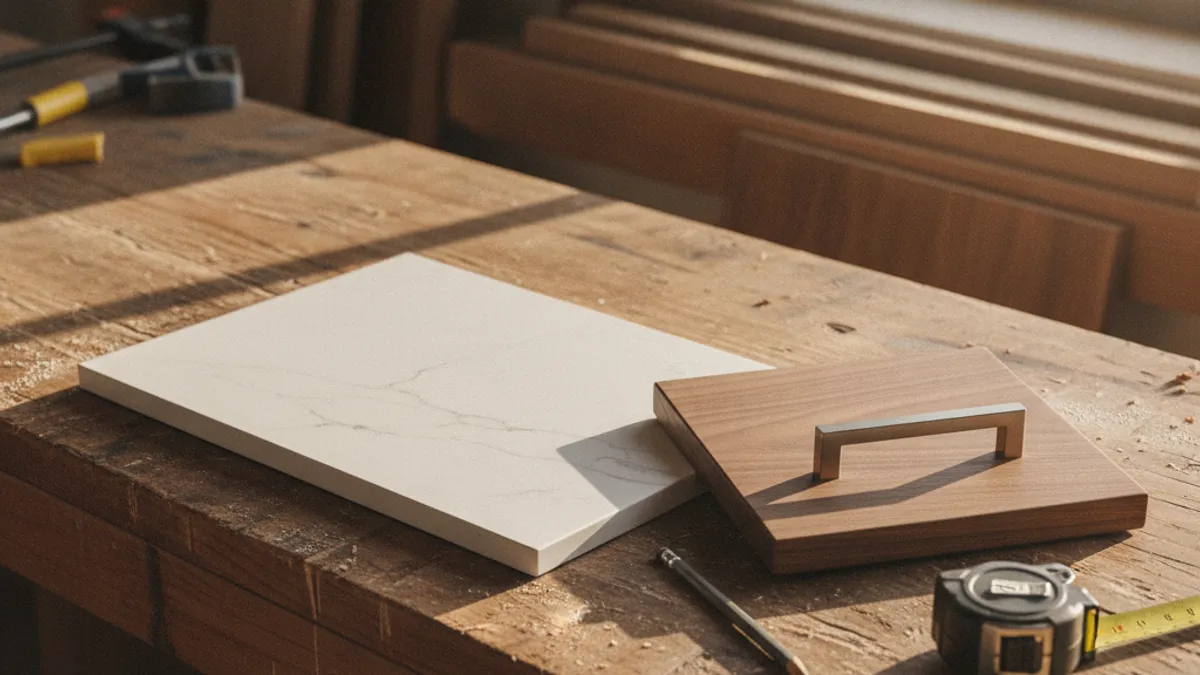
Why the vanity is the second-most-expensive decision in a San Diego bath
The vanity is the line item homeowners underestimate the most. It is also the line item the household uses every day, the line item that defines storage, and the line item that anchors the design. A clean vanity install solves four problems: it gives the household a real counter space, it adds the storage the original 1970s vanity never had, it sets the height and the ergonomics for everyone in the house, and it pulls the whole bath together visually.
The vanity move that works in almost every San Diego bath is a 30-36 inch vanity for a hall bath or a powder room, a 48-60 inch single vanity for a small master, and a 60-72 inch double vanity for a true primary suite. The choices that look good in a render and fail in a real bath are furniture-style legs in a kid’s bath, open shelving at child-height, and a quartz top with a vessel sink in a low-ceiling powder room.
This is a walk through the sizing, the materials, the storage, and the install decisions that actually matter in a San Diego bath remodel.
The four vanity sizes, ranked
24-30 inch single vanity. The right call for a powder room or a tight hall bath. Most 24-30 inch vanities are stock from a big-box supplier.
36-48 inch single vanity. The right call for a typical San Diego hall bath. A 36-48 inch single vanity gives one person a real counter, two drawers of storage, and a mirror that opens the room. Stock and semi-custom options vary widely. Ask for the cabinet and the quartz or solid surface top as separate lines.
48-60 inch single vanity. The right call for a small master bath. The independent remodeler prices the cabinet and top after measuring.
60-72 inch double vanity. The right call for a true primary suite where two people need to use the bath at the same time. Ask the independent remodeler to price cabinet, top, and two sinks after measuring. The double vanity line items are on the master bathroom remodel page.
The vanity installation page has the line items for each size, and the bathroom design page has the layout decisions that go with the vanity choice.
Cabinet materials and construction
Five cabinet materials show up in San Diego bath remodels in 2026:
- MDF with a thermoformed or painted finish. The most common stock and semi-custom material. MDF does not warp in a humid bath. The right call for most remodels.
- Plywood with a wood veneer. Higher end than MDF, with a real wood face on a plywood box. Plywood is more dimensionally stable than solid wood in a humid bath.
- Solid wood (maple, oak, walnut). The premium option. Solid wood cabinets are beautiful, heavy, and priced accordingly. Ask the millwork shop to price per linear foot after the drawing.
- Thermofoil or laminate over MDF. The most affordable stock option. Thermofoil is a vinyl layer over an MDF box, and it is the most common builder-grade vanity.
- Custom furniture-grade. The top of the line. A custom cabinet built by a local millwork shop, with a furniture-grade finish, soft-close drawers, dovetail joinery, and integrated lighting. Ask the installer to price this material after the layout.
The right material depends on the budget, the humidity (an upstairs master with a big shower needs more dimensionally stable material than a downstairs hall bath), and the design intent.
Countertop materials and edge profiles
Five countertop materials show up in San Diego bath remodels:
- Quartz (engineered stone). The most popular choice in 2026. Quartz is non-porous, does not need sealing, holds up to cosmetics and toothpaste, and comes in patterns that mimic marble without the maintenance. Ask the installer to price this material after the layout. The right call for most remodels.
- Marble (Carrara, Calacatta, or similar). The high-end choice. Marble is porous, etches on contact with acidic products, and needs sealing twice a year. The payoff is a one-of-a-kind surface that no quartz can fully match. Ask the installer to price this material after the layout. The right call for a homeowner committed to the maintenance.
- Granite. Less popular than it was 10 years ago, but still a solid choice. Granite is more durable than marble, more heat-resistant than quartz, and less expensive than either. Ask the installer to price this material after the layout.
- Solid surface (Corian or equivalent). Smooth, repairable, and available in integral sink colors. Ask the installer to price this material after the layout. The right call for a tight budget or a kid’s bath.
- Cultured marble. The most affordable stock option, usually sold as a top with an integral bowl. Ask the installer to price this material after the layout. The right call for a builder-grade bath or a rental.
The most common edge profile in 2026 is a 3 cm eased or pencil edge. A mitered edge (the doubled-up edge that gives a 6 cm look on a 3 cm slab) is the design-forward choice for a thick-edge master bath.
The bathroom countertop line items are on the vanity installation page.
Sink, faucet, and mirror choices
Sink. An undermount sink is the standard for quartz, marble, and granite tops, and it reads as clean and modern. A drop-in (top-mount) sink is the standard for cultured marble tops, and it is the right call for a builder-grade bath. A vessel sink is the design move for a powder room, and it requires a taller vanity (32-34 inches) for a comfortable hand-washing height.
Faucet. A single-handle centerset faucet is the most common. A widespread faucet (separate hot and cold handles, 8-inch spread) is the design-forward choice for a primary suite. A wall-mount faucet is the high-end choice for a floating vanity. Name the model on the quote.
Mirror. A framed mirror in the same finish as the faucet reads as designed. A frameless mirror with a polished edge is the clean, modern choice. A medicine cabinet with a mirrored door is the right call for a hall bath that needs the storage. For a primary suite, a pair of round or arched mirrors over a double vanity is the design move that pulls the room together.
Storage decisions that matter
A 30-36 inch vanity has 4-6 cubic feet of storage. A 48-60 inch single has 8-12 cubic feet. A 60-72 inch double has 14-20 cubic feet. Three storage decisions make the difference between a vanity that works and a vanity that frustrates:
- Full-extension soft-close drawers. Drawers that pull all the way out and close with a tap are the single biggest upgrade over stock. Ask the remodeler to price this upgrade.
- A pull-out hamper. A tilt-out or pull-out hamper in a false drawer front hides the bathroom wastebasket and makes the room read as designed. Ask the remodeler to price this upgrade.
- A power outlet inside a drawer. A 120V outlet inside the top drawer (for a hair dryer, a curling iron, an electric toothbrush) is the single most useful upgrade in a primary suite vanity. Ask the electrician to price the rough-in and the drawer outlet together.
The bathroom design ideas page has the full storage and layout checklist for a primary suite.
What a San Diego vanity install actually costs
Bath Pro SD does not set vanity prices. A 36-inch stock hall-bath install, a 48-60 inch semi-custom single, a 60-72 inch double with quartz and two undermount sinks, and a custom furniture-grade vanity with marble are four different quotes. Ask for cabinet, top, faucet, mirror, plumbing, and labor as separate lines after the room is measured.
The line items for a typical 48-inch single:
- Vanity cabinet (semi-custom, painted MDF or plywood): priced after measuring.
- Quartz countertop with undermount sink: priced after measuring.
- Faucet (widespread): priced after measuring.
- Mirror (frameless, 48 inches): priced after measuring.
- Plumbing rough-in and trim: priced after measuring.
- Install labor: priced after measuring.
- Electrical (if a new outlet or a GFCI is added): priced after measuring.
- Permits: priced after measuring.
For most projects, the cabinet and the top are the line items that move the budget. A mid-range semi-custom cabinet with a mid-range quartz top lands in the mid-range. A custom furniture-grade cabinet with a marble top climbs to the high end.
What to ask a vanity install contractor
Three questions separate a clean vanity install from a corner cut:
- Is the cabinet box plywood or MDF? Plywood is more dimensionally stable in a humid bath. MDF is fine for a hall bath. The honest answer depends on the bath.
- Is the top a separate line item from the cabinet? A quote that lumps the top into the cabinet is missing the cost of the slab, the sink cutout, and the faucet holes.
- Is the plumbing rough-in showing a supply line, a drain move, and a vent (if needed)? A vanity swap in the same location is a different quote from a vanity move that relocates plumbing.
A good crew will not flinch at any of these questions. For the full bath scope that usually pairs with a vanity install, the full bathroom remodel page has the line items.
Call (858) 400-4896. Bath Pro SD matches you with a licensed independent remodeler. That person measures the room and writes the scope and price. The crew measures the bathroom, looks at the plumbing, and tells you what size and what material vanity fits the room and the budget, and what the install actually costs.